
Policy: JICJ
Section: J - Students
Student Use of Personal Communication Devices
Purpose
This policy establishes clear, consistent, and equitable boundaries on student use of personal communication devices during the school day. Its purpose is to support focused learning, reduce distraction, and promote in-person interaction, guided by a framework of learning and wellbeing rather than punishment. Families and students will be engaged as partners in its successful implementation.
Definition of Personal Communication Devices
For the purposes of this policy, a “personal communication device” (PCD) means any privately owned, portable electronic communication device. PCDs include, but are not limited to:
Cell phones;
Smart or electronic wearables.
Wireless earbuds and earphones;
Personally owned tablets and laptops;
Non-District-issued computing devices; and
Any other personally owned, portable electronic communication device.
Prohibition on Use — On Campus
Student use of personal communication devices is prohibited during the instructional school day while in the school building or on campus, for all students in all grade levels (ECE–13).
The school day includes, but is not limited to, instructional time, passing periods, lunch periods, homeroom/advisory period, restroom use and all other times during the designated school day while in the school building, on campus, or on a school field trip. During all such times, PCDs shall be turned off and out of sight.
It is the student’s responsibility to ensure that PCDs are turned off and stored in accordance with this policy and with school-specific rules during times when use is not authorized. A PCD that produces any audible sound, ring tone, or vibrating alert, or that is displayed or otherwise in plain view during prohibited times, shall be deemed to be used in violation of this policy.
Storage of Devices
Throughout the instructional school day, PCDs shall be turned off and kept out of sight. The building principal or designee shall determine the storage method appropriate to the individual campus, which may include:
Requiring students to keep PCDs turned off, out of sight, and not on their person, and stored in a backpack, bag, locker, or other personal storage area; or
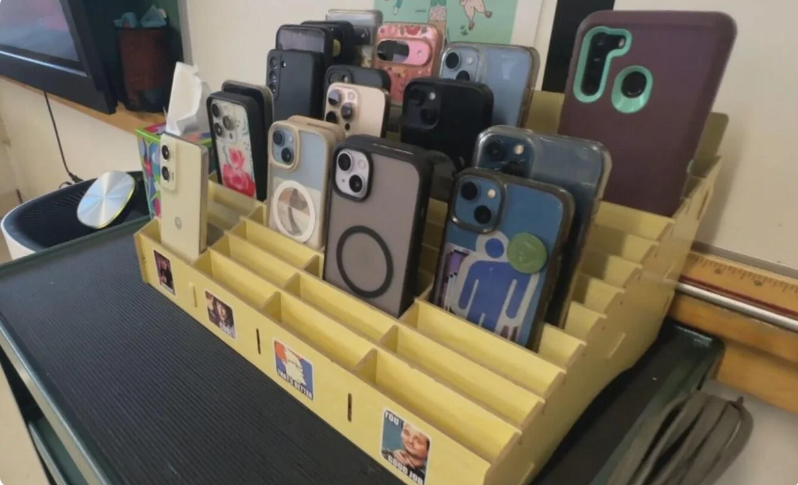
Implementing a school-managed storage system, such as secured pouches, caddies, lockboxes, or a centralized check-in and check-out process.
Each school shall communicate before the first day of class its chosen storage method clearly to students and families before it takes effect. Storage methods shall be applied consistently within each school site and implemented in a manner that is simple, transparent, and equitably enforced.
Exceptions
Students may possess and use PCDs during the instructional school day, or when use would otherwise be prohibited, when specifically authorized under a current Individualized Education Program (IEP), a Section 504 Plan, to meet the language needs of a Multilingual Learner, or an Individual Health Plan. Students may wear prescription smart glasses, provided the glasses are powered off and disconnected from any phone or other communication device.
Information regarding a student’s exception under an IEP, Section 504 plan, or health care plan shall be shared only with staff who have a legitimate educational interest, consistent with the Family Educational Rights and Privacy Act (FERPA).
Conduct Strictly Prohibited Regardless of Any Permitted Use
Even when use of a PCD is otherwise permitted under an exception above, the following conduct is strictly prohibited:
Engaging in, promoting, or facilitating any conduct that violates the Student Code of Conduct, other Board or Administration policies or regulations, school-specific rules, or state or federal law.
Using a PCD in any manner that causes or results in disruption of the educational environment or school-sponsored activities, or that impairs or interferes with school or District operations.
Photographing, recording, or sharing images or recordings of other students or school staff on District property or at school-sponsored activities in a manner that causes, or could reasonably be expected to cause, emotional distress, embarrassment, or humiliation, or that invades or violates any person’s reasonable expectation of privacy.
Using cameras, recording features, or any PCD in locker rooms, restrooms, or other locations where the presence or use of such a device poses an unreasonable risk to the safety, welfare, or privacy of others, as determined by the building principal or designee.
Using a PCD to engage in bullying, harassment, threats, academic dishonesty, or unlawful activity of any kind.
Violations and Progressive Response
Responses to violations shall emphasize de-escalation, restoration, and re-engagement in learning. Enforcement shall be consistent, transparent, and equitable across all school sites. A student shall not be suspended or removed from their regular instruction day solely on the grounds that the student possessed or accessed a PCD in violation of this policy; however, conduct that independently violates the Student Code of Conduct may be addressed under the applicable discipline policy. Every violation shall be documented by the school.
When applying the progression below, the building principal, designee, or staff member may consider the time between violations, the student’s overall compliance with this policy, and any other relevant circumstances. If a student has followed the policy for a substantial period of time, the principal, designee, or staff member may restart the progression at Step 1.
When a violation occurs, the staff member shall first direct the student to turn off and put the device away. The following four-step progression shall be applied to violations occurring within the same school year:
Step 1 — First Violation: Warning and Redirection
The student receives a verbal warning and is directed to turn off and store the device.
The student is reminded of the policy expectations and the reasons for them.
The incident is documented by the school.
Step 2 — Second Violation: Confiscation and Return at End of Day
The device is confiscated by school staff and held securely. Before surrendering the device, the student should turn it off.
The device is returned to the student at the end of the school day.
A parent or guardian is notified of the violation.
Step 3 — Third Violation: Confiscation and Parent/Guardian Conference
The device is confiscated and held securely in the main office.
The device is returned only after a conference among the parent or guardian, the student, and school personnel to review the policy and develop a plan for compliance.
The school may require the student to check the device in at the office at the start of each day and retrieve it at dismissal for a defined period.
Step 4 — Fourth and Subsequent Violations: Referral and Disciplinary Action
The matter is referred to school administration for accountability and support.
Accountability and support may include continued daily device check-in, loss of the privilege to bring a PCD to school, searches, a behavioral contract, detention, or other interventions.
Responses shall be tailored to the student’s age and circumstances and shall prioritize re-engagement in learning over exclusion from it.
A student who refuses to surrender a PCD upon the request of a teacher or other school official shall be subject to disciplinary action under the Student Code of Conduct, independent of the step-level progression above.
The building principal or designee may, at their discretion, establish and enforce additional rules for PCD use within the school building appropriate to individual campus needs, provided such rules are consistent with this policy and applied equitably.
Confiscation of Devices
PCDs reasonably suspected of being used or possessed in violation of this policy are subject to temporary confiscation by school authorities. The purpose of this policy is to implement a device-free school day, not to investigate wrongdoing. Accordingly, devices confiscated under this policy shall not be searched.
Emergency Notifications and Family Communication
This policy shall not prevent or impede the delivery of emergency notifications. The District is responsible for ensuring that emergency notifications reach parents and guardians. Each school shall provide families with at least one reliable method to contact their student during the school day, ordinarily through the school office, and a method for students to reach a parent or guardian when necessary.
Students are not authorized to use PCDs during emergencies, including active-threat or lockdown situations. Personal device use during such events can compromise student and staff safety, interfere with the emergency response, and spread misinformation. Official information and communication during an emergency will be directed through school and District channels.
Loss, Theft, or Damage
The District is not responsible for the loss, theft, or destruction of property, or while a student is attending District or school-sponsored activities or events. This shall be communicated clearly and consistently to families. Students who bring PCDs to school do so at their own risk. Personal communication devices brought onto school or District.
Notification and Implementation
This policy and each school’s storage and enforcement procedures shall be communicated to students and families before taking effect and at the start of each school year, including the method by which families may contact students during the day. Implementation shall be consistent, transparent, simple, accountable, and equitably enforced across all school sites.
Grades shall not be reduced solely as a consequence of a violation of this policy.
Adoption Date: July 27, 2026